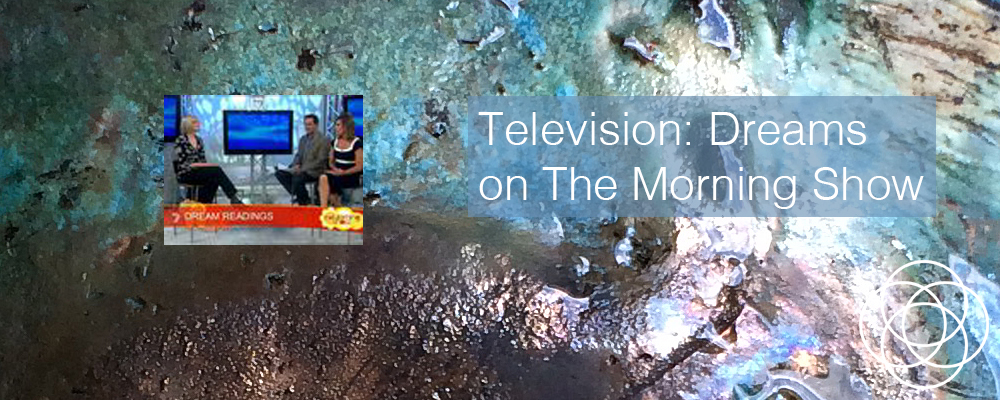
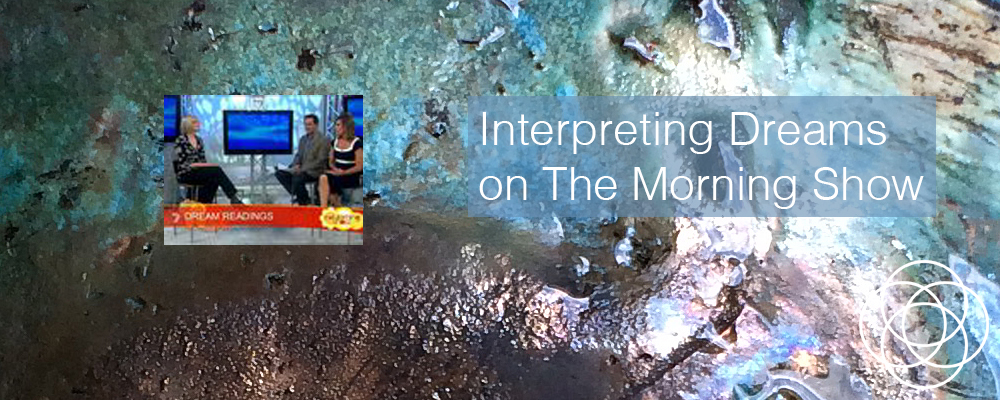
Here’s the video of my dream interpretation segment on Channel 7, The Morning Show, (national television Australia), this morning:
I was on The Morning Show this morning with Larry & Kylie, interpreting dreams. As usual, they had sent the crew onto the street to film people describing their dreams.
A woman asks about her childhood dream of falling into puddles, some with sharks in them, some with dolphins. There’s a dream about refereeing a football match, one about getting married, one about amazing paper planes and one about a door in a desert. What do they all mean?
Watch the film clip to find out. Enjoy!
Ingrid Arna asks me about her dream of eating kitten curry in this new short video. I hadn’t heard the dream before, so you can watch the process as we go – Ingrid describing her delectable 3-kitten gourmet dish, me asking key questions and interpreting, Ingrid responding with how the interpretation relates to her waking life, and some dream alchemy.
When I have a guest on my weekly podcast, The Dream Show, you get to hear the same process over a longer period – often 40 minutes. In today’s video you get a much shorter version and the opportunity to watch our responses, rather than just listen.
Which format do you like best, podcast or video? Why?
Here’s a new video, released today, on sex dreams and what they really mean.
Do you remember Ingrid, my guest on episode 80, The Dream Show? In that episode she asked me about her dream of meeting two celebrities. The interpretation shed light on an issue stemming back to childhood that Ingrid was ready to fully release. In this new video, Ingrid asks me about a sex dream she had.
Ingrid, an holistic health counselor, body image expert, and accomplished host presenter, produced this three part series in which she interviews me about dreams, dream interpretation and relationships. Enjoy, and please share.
Sunrise invited me onto the breakfast show this morning to talk about sexsomnia and other forms of sleepwalking. Here’s the clip from the show:
What is sexsomnia? Channel 7 are screening a documentary tonight, Sleep Walkers: Secrets of the Night, focussing on sleepwalking in its many forms, including sexsomnia, a distressing condition where a person, usually male, tries to have sex with his partner while he (the sleepwalker) is asleep. The sex is usually rough and mechanical, and, of course, extremely distressing to the partner who is the only one of the pair to have any memory of the event in the morning. 100,000 people are believed to have sexsomnia in Britain.
Do you ever wake in fright from nightmares? How often? According to new research reported by Victoria University PhD candidate Fabian Elzo, 16% of Australians (that’s nearly 1 in 6 people) wake in fright from a nightmare once a week. Previous research across the world suggests the figures are closer to 4-10%. So, do Australians suffer more nightmares? Elzo’s study group were all students aged 18-34 years, and perhaps that skews the stats, but either way, imagine the number of people all over the world waking in fright on any given night, not knowing how to stop this from happening.
Are you surprised the figures are so high? Many suffer in silence, fearful that admitting to having nightmares might cast aspersions on their mental stability, or – worse – that talking about them may make them come true.
A nightmare is just a dream, but with an added shot of adrenalin. Many of our dreams process our unconscious fears, but the really graphic ones can stimulate our bodies to produce adrenalin (the fear hormone), and it’s that combination of graphic horror and real heart-pumping, creeping goose bumped, frozen panic, that wakes us up in fright.
I give tips on how to stop nightmares in this video clip of today’s segment on Sunrise.
But I bet you’re waiting for the sleep yourself skinny bit, right? We chatted about this in today’s segment too. Recent research adds momentum to previous studies suggesting that disturbed sleep can disturb your metabolism, resulting in putting on weight. The new research suggests that people who regularly get only 4-5 hours sleep a night may experience disturbances of two important hormones – insulin and leptin.
Insulin normally controls your blood sugar and fat levels, and leptin helps control your appetite. This research suggests that only sleeping 4-5 hours most nights can result in your insulin storing more of your calories as fat instead of converting them into energy, while your leptin levels are so disturbed that you no longer get that full feeling when you eat, so you just keep on eating.
Can you sleep yourself skinny? No, but if you’re a short sleeper and you’ve been stacking on the fat, longer sleeps might redress the balance and you could well find yourself losing some of that extra padding.
If you really want to ‘sleep yourself skinny’, gather some dreams while you sleep and interpret them. Fat is often a bodymind issue, and dreams can reveal your unconscious emotional patterns and beliefs that are driving you to eat more, or to eat the wrong kind of food.
Food for thought. Sleep (well) on it.
Happy Blog Birthday to us! Join me for a slice of chocolate birthday cake in this little video to get the inside info on today’s celebrations and gifts.
Yes, I’ve been blogging for a year today, ever since Euan urged me to “write a blog Mum!” Why did I need a blog when I had a popular 11 year old, constantly evolving dream website, I asked my friends. “Write a blog Jane Teresa!” they all replied. So I did. A chocolate-coffee coloured blog, and I started with a post about dog poo. And never looked back. Post by post I discovered the difference between a blog and a website, and nurtured both.
And then you all came along and gave suggestions, told me what you liked, what you didn’t like. The dog poo story rated. Looking back, what were some of your favourite posts?
What do you think of our birthday makeover (new title, new header, completely new colours and design)? I’ve got some wonderful people to thank for this, but first I want to tell you about the five big gifts, each valued at $440, and what to do to win one for yourself. The gift you can win is to have me at your next dinner party or event for two hours. I won’t be able to share your meal, because I’ll be on skype, on your laptop or plasma screen, giving eight of your guests 15 minute dream readings. So you’ll have me on hand for two hours to interpret dreams. Sound like fun? Simply email me at [email protected] with one piece of feedback about our makeover and one idea for a future blog topic. I’ll pick my five favourite ideas a week from today (on October 28) and notify the winners over email. (The prizes must be redeemed within a month from notification.)
To Carmel Glover, Graphic Designer & Book Artist, and Belinda Hodge, Word Press Designer, for inspired design and several very late nights this week sweating out all the big stuff that goes into a blog makeover.
To Nina Tovey, my agent, for suggesting the makeover and other brilliant adventures, and, like Carmel and Belinda, always following through until the job is done, whatever it takes.
To Michael Collins, my husband, for his speedy production of web images, recording our podcasts, and enjoying other new media adventures like making videos with an iPhone to share with you on the blog. That’s in his spare time, when he’s not ghostwriting. And no, to answer the question on many people’s lips, Michael doesn’t ghostwrite my stuff. I write my own books, blogs and articles, so please do let me know what you like, what you don’t like, and I’ll blog on accordingly.
To you, readers and dreamers, thank you for being a part of our ever-growing dream community, and for being here today to celebrate with me wherever you are in the world. Go on, have a piece of chocolate cake! Oh, and if you haven’t already, please ‘like’ me on Facebook. We’re trying to reach 1000 likes to build our community of dreamers so why not suggest me to a friend?
Happy Birthday.
What’s in a dream symbol? Here’s a question for you in this little video. Watch and share your answer in the comments here or on Facebook. Enjoy!
Have you ever dreamed of having sex with a celebrity? Or have you ever turned up at work, looked a colleague in the eye, and suddenly remembered a dream you had last night? You know, the dream where you two were having sex and … Mortified you avert your eyes, blush, stutter, wonder if it was a shared dream, a deeply buried fantasy, or a telepathic desire beamed out by your colleague while you slept.
Admit it. Everyone, absolutely everyone, has had, and will have, this kind of dream. It’s normal and natural, and the only reason we think it’s not is that everyone’s too embarrassed to talk about it.
It’s also 100% symbolic, so don’t follow through with ‘I had a precognitive dream about you last night’, or treat the poor, unsuspecting, innocent colleague with disgust. It’s all about you!
(This article continues below this video of me talking about sex dreams:)
Sex in dreams is about what qualities or attitudes you are integrating into your life, as sex is a brilliant symbol of integration where two bodies become one. Ask what three words best describe your dream lover’s personality or approach to life. Go on, do it! Then write them down! These are the qualities your dream is integrating into your being. Good sex: good integration. Bad sex: warning, think again about your new approach.
Recent research has got people all excited about a possible link between people who thrash about in bed while they’re dreaming and the later development of dementia, in particular, Parkinson’s Disease. Here’s a video clip of me talking about this on The Morning Show, Channel 7, this morning.
So let’s have a look at this:
Normally, we don’t thrash about in bed while we’re dreaming. We might toss and turn between dreams, and we might twitch during a dream, but that’s about it.
We’re protected from acting out our dreams by a mechanism called ‘sleep paralysis’. Your dreaming brain flicks a switch to inhibit your skeletal motor muscles from moving. You’re kept safely tucked up in bed, no matter what you’re up to in your dreams.
Some people experience a REM sleep behaviour disorder where sleep paralysis doesn’t kick in. When they dream, their muscles move accordingly. They act out the more dramatic parts of their dreams. They may kick, punch, jump, or even get out of bed. Some people experience this sleep disorder every night; others occasionally, maybe once every couple of weeks, and the episodes last about 2-10 minutes. If they wake up and describe their dream, it generally fits the movements they’ve been making.
(This is different from sleep walking and from restless legs syndrome, both of which occur in non-dreaming phases of sleep.)
It’s commonly believed that the dreams people act out are always bad or violent, but it’s more likely that all dreams are acted out but because the bad or violent ones involve more activity (punching, running away), they are more noticeable.
The dreamer, or his (people with this disorder tend to be older men) bed partner may be hurt – or killed – during one of these episodes. Controversy has surrounded cases where people have murdered their bed partners and claimed innocence due to suffering this disorder.
Back to the recent research:
Mayo Clinic researchers found a possible link between this sleep disorder and the later onset of dementia, particularly Parkinson’s Disease. They analyzed the medical records of 27 people who suffered from this sleep disorder and who all developed dementia up to 50 years later, and concluded that there may be a link.
Of course, this is NOT to say that if you have the sleep disorder you’ll develop dementia within 50 years. Plenty of people suffer this disorder and remain mentally fit and healthy into old age. However, this research may provide a clue to help neurologists understand dementia.
REM sleep behaviour disorder is treatable with drugs, so see your doctor to ensure a good and safe night’s sleep, for yourself and your bed partner.
Watch the video of me talking about this on The Morning Show, Channel 7, this morning.